Wednesday, June 19, 2019

Responding to Classmates

Our last Blogg

I am sorry if I miss your response. I thought everyone did a great job but I am only going to respond to a few of them that really stood out or resonated with me.

Several of us were on the same page on the question of how to create flow for our lesson plans. I know that Julie, Ali, and Carly all mentioned that they had difficulty finding the correct flow for their lessons. I did as well. When I first set up my lesson design I had lesson 3 and 4 switched but when I looked closer at it I knew that if I was really doing this with students I would have the lessons in a different order. The key is creating connections and providing the students with the scaffolding that they need in order to learn.

Katie- Your comment about feeling like you were needing to repeat parts of your lesson resonated with me. The truth is some part of our lessons will need to be repeated. When I did my scope and sequence I was working with first grade. There are many fundamental areas that will be covered not just in one lesson but repeatedly throughout the school year. It is important to remember that while we need to hit on all of the standards there are some standards that are more important than others.

Autumn- When you commented on gauging the time for a lesson I had to laugh. The first few times that I taught in my classroom by myself I often miss gauged the time I would need to teach a lesson. After you have been in a classroom you will find that like the students you become very used to the schedule. Your internal clock will also most tell you, "Hey, its time to move to the next part of the school day." But I also found this part of the lesson a bit unauthentic because we know that some of these lessons will take more time than others.

Kim-
Some of the schools are pulling away from lesson plans. They are becoming more generalized. As a beginner teacher though I will need these lessons so that know what I am doing each day. I don't want to wing my student's education.
Joshua- I also agreed that writing up modifications and extensions for these lesson plans can become a bit unauthentic. What I try to do is think about the different students that I have had. I gear my extensions towards these students and I do the same for modifications. For me, it helps it become a bit more authentic in my mind.

Enjoy Your Summer Everyone!

Thursday, June 13, 2019

Books from Book Reviews


Choosing a book can be very difficult. The library is full of great books but which ones do we want to read in our classroom. I am going to list three books that I plan on adding to my classroom library.

Aunt Harriet’s Underground Railroad in the Sky by Faith Ringgold
Awards: Although the author herself has gained many awards for several of her books, this book received the Jane Addams Children’s Book Award for Picture Book in 1993.

This book employs a lot of imagination. It is written in first person narrative and starts out with a young girl explaining that one day she and her baby brother were flying among the starts. The pictures are painted without dimension as though a child might have drawn it. Throughout it though, here and there, the reader can see added details that make the artwork very unique. In the sky, the two children find an old ramshackle train. At the door of the train stands a woman, the conductor of the train. Around the train stand a multitude of ghostly figures. The woman is calling these ghostly men, women, and children to board the train, the train that is bound for Freedom.
The conductor finally introduces herself to the girl as Harriet Tubman and a conductor on the Underground Railroad. She begins to tell the young girl about slavery, the fear and the cruelty by those who suffered under it as well as the price it took for freedom.
The dream quality seems to change and the girl is sucked into the past. She must escape slavery and find her own way to freedom. Following the North Star, the young girl escapes her plantation, hides in the safe home of a young farmer couple, and then that of a blind woman’s. Along the way she looks for clues and signs that the places she is going to truly are part of the Underground Railroad. Some of the signs are songs of slavery and freedom. Some are signs sown on to quilts or Show Away’s that point the way to freedom. The girl faces many perils as she travels north to Freedom. She is always looking over her shoulder for the bounty hunters who would take her back into slavery. The story ends in celebration as the young girl enters the Canadian border and is reunited with family and friends. They celebrate their freedom and those that sacrificed so that they could have it.
This book would be a good addition to a lesson during Black History month. It would be fun to use with a Web Quest that would assign students different aspects of the Underground Railroad that they could look up. 

Show Way by Jacqueline Woods
Awards: This book received the John Newbery Medal Honor Book in 2006

Okay, this little picture book brought tears to my eyes. The story was about slavery and freedom. Instead of look at the larger picture of those seeking freedom, this book looked at one family’s road to freedom. It was about a family who rather than running away to find freedom, provided those that came to them the map to freedom. The map was sown into quilts called Show Way. As each daughter down the line was sold away into slavery, they brought with them the tools and the knowledge to show the way to freedom for those who sought escape. This was a heartwarming, heart-wrenching tell of the cost of freedom.
As a teacher, I will be adding this book to my collection. It will be a book that I will be reading to my students. I love the heroism that I saw in this book and the selfless sacrifice. As far as a lesson I will have to think more about it. This book would deserve something special. I like the idea of a lesson on self-sacrifice but I would have to also work that into some of my standards.

Blackout by John Rocco
Awards:
·         Caldecott Honor Book in 2012
·         Borders Original Voices Award for Best Picture Book
·         Original Art Show in Society of Illustrators
·         New York Times Best Book of the Year

 What happens when the lights go out? In this book we get to watch a busy family’s reaction to a blackout. They light candles and play. They then go up to the rooftop and see all the stars. They are amazed by these beautiful natural lights. They then go outside where the fire department has opened the pipes to let the kids play. A block party has ensued as families seek relief from the heat.
A lesson with this book would be science connected. I would read this book as a connection with how light travels and what might affect the lights.

Harry and Hopper by Margaret Wild
Awards: 2010 Greenaway Medal Winner

This is a very sad book. It is about a young boy and his dog. The boy plays every day with his dog. They run, hide, play catch and love each other. The dog Hopper sleeps with his little boy every night. An accident though takes place and Hopper is killed. Harry does not know how to say goodbye. He dreams about hopper every night until he is finally able to tell him goodbye.
I would probably not make a lesson out of this book. On the other hand, I think that it would be a great book to include in a classroom library to help kids who are going through loss.

Friday, June 7, 2019

Blog #6

Books

“Books are a uniquely portable magic.” - Stephine King

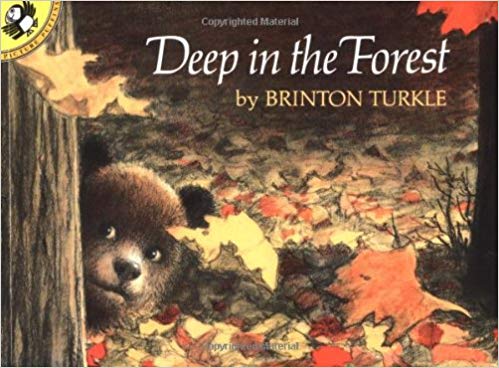
For this blog, we are supposed to be looking at the books that we will be using for our unit lessons. My first lesson will be Making Prediction (The book used “Goldilocks and the Three Bears” by Jan Barret) This book is a very well written and illustrated version or the original story. The book is easy to follow and does not have any strange twist or turns to it. It will be very easy to use to help my students make predictions. I might also pair up a non-traditional version of the story as well. I like the book Deep in the Forest, By Briton Turkle. In this story, the baby bear stumbles across a cottage in the woods. It would be fun to make comparisons and predictions between the two.
    

My second lesson will be Asking and Responding to Relevant Questions (The book used “This is Not My Hat” by Jon Klassen) This book follows a fish who has stolen a hat from a much larger fish. The little fish thinks that he will not be caught but the reader sees the chase that is happening that the little fish does not. This book gives students a lot of room to ask questions before, during and after they read. It would also be paired up well with its partner book "I want my hat back" by Jon Klassen. Using these books together would help students make connections and generate lots of questions.
     

Lesson three will be Retelling Main Idea (The book to be used “Big, Blue Whale by Nicola Davis)
In this story, the narrator describes a Big, blue whale, and the adventure that the whale takes around the world. I might also read White Owl Barn Owl by Nicola Davis much like the Big, Blue Whale, the story describes the journey of White Owl

  Paperback White Owl, Barn Owl : Read and Wonder Book 

Lesson four will be the Main Idea in Sequence (The book to be used “The Going to Bed Book” by Sandra Boynton) This is a cute little story that follows a group of animals on a boat as they get ready for bed. Sometimes they do normal things like brush their teeth but other times they do odd things like exercise. This is a fun book and has a very clear sequence of events. The Napping House by Audrey Wood is also great for sequencing as everyone piles on to the bed to sleep.

    815234 

My final lesson will be Retelling Main Idea (The book to be used is "Max's Words" by Kate Banks) In the story Max's brothers each have collections that they will not share so Max decides to create a collection of his own. He starts cutting out words. I think that I would pair this book up with I Lost my Tooth in Africa by Penda Diakite. Both of these books have strong main ideas and are beautifully illustrated.


Thursday, May 30, 2019

Week 5

Lesson Plans

This week we were given the opportunity to present one of our lesson plans. I always worry about my lesson plans. To me, they look like fun and great ways to help students learn but I often worry that they will come off silly to other people. Presenting these lesson plans to my peers and to our professor gives me confidence. I feel that I could get in front of a classroom of students and that they would understand and grow from what I have to teach them. 

I love the set up that we have been given to create creating our objective. I had Dr. Steffes in my classroom Management class and she showed us how to use these steps to create lesson plan objectives. It was a game changer for me. Before then I was always missing parts of the objective now I just fill it in step by step. I am then easily able to refer back to it throughout my lesson plan to make sure I am fulfilling my objective.
 

Presenting in front of the class also helped me see the areas that I had made assumptions. For example, I made the assumption that people could easily see how students would be making predictions and testing these hypotheses. But, when I presented I was able to step back and view it from the perspective of someone who was not setting in my mind. As teachers, we might not always be there. We need to have lesson plans that are clear enough for our sub to pick up and follow.

Friday, May 24, 2019

Off Week

The assignment for this week says that it is an off week. It told us to catch up but I already did so I thought that I would take a look at some graphic organizers.


I really like KWL organizers. I think that they help the students really think about what they already know about the topic. Too many times students will just say I don't know but if they take the time they have a lot more schema then they ever realized. I also think that it is important that students take the time to reflect on what they would like to learn more about and how to make sure they are being relevant to their reading. Then students are given the time to reflect on what they have learned. How many times do we hear our students or even our own kids answer the question "What did you learn at school today" with an "I don't know" or "Nothing". I believe that when a student takes the time to acknowledge what they have learned there is a better chance of it sticking with them.


I call this one the main idea burger. It helps students really look at what the main idea was and what details were available to help support those ideas. Sometimes as advanced readers we make assumptions that our students can see the main idea clearly. This sandwich helps them piece together they why.

Wednesday, May 15, 2019

5 Fun Ways to Teach Vocabulary


Eye Spy 

Give students a list of words to search for in a text or have them find unfamiliar words. You can award points to the words based on different criteria This can be done as a pre-reading activity.

Word Pairs 

Give students words in pairs and have them evaluate if the words are the same, opposite, go together, or are unrelated.

Games 

Real games can be a great source of vocabulary play and practice. Examples of games include Balderdash, Taboo, Blurt, and Scrabble.

Word Wheel 


Students spin the wheel to see if they will draw, act out, rhyme, define, given a synonym or antonym of the word.

Vocabulary Photo Album 

Have students clip pictures that represent the vocabulary word. These could be placed in a photo album or in a word journal.  

Friday, May 10, 2019

Week 2
Word Wall Ideas

image.png
This one is very simple but I like it because I know that wall space is very limited in the classrooms that I will probably be teaching in. It is also easy for students to find the word if they know the beginning letter sound. This would be grade appropriate for 1st grade.

image.png
I like this one because it also introduces the idea of word families and blinds. It is still very simple and would fit into a smaller space.

image.png
Once again you can use word families and images to help make the connection easier.

image.png
I like this one because it makes the words more personal to the students. They can take them down and use them. It could be used in writing or even in games.

image.png
If I had enough room in my classroom though, something like this would combine the best of both worlds. I would put the words on an index card going down the row of letters and then have the flip ring for individual students use or games. But if space was in short supply I might have to get creative with it.